The IMF (International Monetary Fund) estimates that global financial institutions could suffer more than $4 trillion in losses with the U.S. leading the way with a total of $2.7 trillion - double of what IMF predicted six months ago. In order to bolster capital reserves, the Obama administration seems to have little option but to convert some of the $200 billion in loans to ailing banks into common stock. And this is one of the reason why you should avoid banking stocks because the floating shares would be enlarged thus diluting the share price. So far country such as Malaysia has not shown any sign of severe recession, thanks to jobs well done in covering the actual situation.
There’s no doubt that the Malaysian financial institutions are better equipped after the 1997-1998 Asia Financial Crisis. However that doesn’t mean these banks are insulated from the effect of the current global crisis. The latest move by banks in raising interest rates for purchases on non-national (meaning non-Proton) cars could open the Pandora-box – the NPL (non performing loans) from car loans could be deadlier than expected. However, the immediate reaction and perception was the government is trying to help national car makers, Proton Holdings Berhad (KLSE: PROTON, stock-code 5304. Coincidently this strange measure of raising interest rate happens during the new Najib’s administration with his mentor Mahathir observing over his shoulder.
 Hire purchase interest rates for new non-national cars (such as Honda, Toyota and Nissan) have increased to 3.25% for loan tenures of five years and below, 3.4% for six to seven years and 3.5% for eight to nine year loans - previous hire purchase interest rates were in the range of 2.4% to 2.5%. On the other hand Maybank has started slashing interest rates for Proton cars – 3.5% for loans of five years and below, 3.65% for loans of six to seven years and 3.75% for loans of eight to nine years. Previously Maybank charged flat rate of 3.75% for Proton cars.
Banks are said to be trying to recover losses from NPL by raising the interest rate for non-national cars but seriously it’s more like an attempt to push the buyers from the non-national cars cage into Proton cars cage. Those who can afford Honda, Toyota or Nissan will never look back. But buyers who are considering trading in their Proton for the Japanese cars and has just enough budgets to do so may put off their plans now. Already the Malaysians are being slapped with unfair excise or sales tax on non-national cars, giving advantage and different playing field to Proton. Decades of unfair advantages are also the reasons why Proton is still the village champion, unable to compete when it try to expand its wings into other countries.
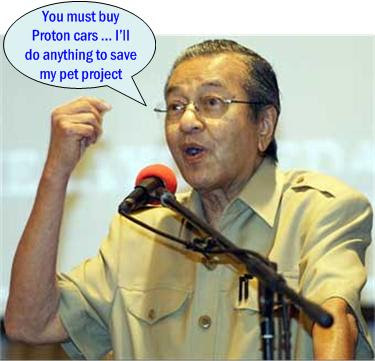 Proton, the brainchild idea from Mahathir, has lately awaken from its’ slumberland and added more models such as Proton Saga and Exora. Now that Mahathir has come back as a shadow in Najib’s administration it should not surprise anyone if the latest idea was his to shut people who owning non-national cars and again force the average-Joes to Proton cars, infamous for its power-window mulfunctions trademark. It’s a known fact that in “true playing field” Proton could collapse and disappear from the automobile industry. Nevertheless non-national cars can still sell their cars with creative and innovative promotional programmes of which the interest rate could be very competitive. Maybe Mahathir wants to kill or ban such promotional activities as well. Before he do that maybe he should get rid of this Porsche Cayenne.

 The deal will end Sun's 27-year history as Silicon Valley's brash independent and give Oracle ownership of the Java programming language, which runs on more than 1 billion devices around the world. With the acquisition Oracle is expected to venture into storage and computer hardware as it accelerates its attempts to become a one-stop technology shop for more than 300,000 corporate, government and academic customers. As usual the question would be the number of excessive staffs to be axed - Oracle employs about 86,000 people worldwide while Sun has about 33,000 workers.